There is a particular kind of freedom that comes from standing on the deck of a Greek ferry as the white-washed cubes of one island shrink behind you and the craggy silhouette of the next rises ahead. TOPEIRAXTIRI.GR has spent years documenting this experience across the Aegean, and the verdict is unanimous: Cyclades island hopping is one of the most rewarding journeys you can plan in Europe. Thirty-three inhabited islands, one ancient sea, endless combinations.
This guide is built for travellers who want practical, honest advice — not a glossy brochure. You will find ferry logistics, island-by-island character profiles, a ready-to-use planning checklist, and answers to the questions that actually come up when you are standing at Piraeus port with a backpack and a loose itinerary.
Why the Cyclades Are Perfect for Island Hopping
The Cyclades sit in the central Aegean in a rough circle around the sacred island of Delos — hence the name, from the Greek kyklos, meaning circle. This geography is a gift for hoppers: no island in the chain is more than a few hours by ferry from its neighbours, and the connections are frequent enough that you can reroute spontaneously without losing a day.
The second reason is variety compressed into a small space. Santorini’s volcanic caldera, Naxos’s medieval towers, Milos’s coloured cliffs, Amorgos’s cliff-hanging monastery — these landscapes would be spread across hundreds of kilometres on a mainland road trip. Here, you cross them by boat in an afternoon.
Third: the wind. The meltemi blows strong from the north in July and August, churning the sea into dramatic swells. Experienced hoppers treat it as a natural alarm clock that pushes them towards the calmer southern islands or indoor taverna afternoons. Learning to read the meltemi rather than fight it is the single skill that separates stressful trips from legendary ones.
Understanding the Ferry Network
The two main departure ports are Piraeus (Athens) and Rafina (a 45-minute drive or bus ride from Athens centre). Rafina is smaller, less crowded, and marginally closer to the northern Cyclades — Mykonos, Tinos, Andros. Piraeus connects to virtually everywhere.
Two types of vessel dominate the routes. Conventional ferries are large, slow (five to eight hours to Santorini), and cheap. They carry vehicles, have proper restaurants and cabins, and are the civilised choice for overnight legs. High-speed catamarans cut journey times in half but cost roughly double, do not carry cars, and can be bouncy in a meltemi. For hops between islands — say Naxos to Paros — the catamaran wins on convenience. For the long run from Piraeus to the southern Cyclades, the overnight ferry lets you sleep and save a hotel night.
Book through the official ferry operators’ websites or a single aggregator like Ferryhopper. Always check the exact departure port for each island — some islands (Santorini, Milos) have more than one harbour.
Choosing Your Islands: A Framework
The most common mistake in Cyclades island hopping planning is choosing too many islands. Three or four islands in ten days is the sweet spot for most travellers. Five or more becomes a logistics exercise rather than a holiday. Use the following profiles to build your shortlist.
Santorini: The Volcanic Icon
Santorini earns its reputation and its crowds. The caldera view from Oia at dusk is genuinely extraordinary — one of those moments that matches the photograph. The island is best approached as a two-night stop: one day for the caldera villages (Fira, Oia, Imerovigli), one day for the volcanic beach circuit (Red Beach, Perissa, Perivolos). Any longer and the tourist-trap density starts to wear. Arrive by ferry rather than cruise tender: you dock at Athinios port, take a bus up the switchback road, and avoid the Fira cable-car queue entirely.
Mykonos: Energy and Architecture
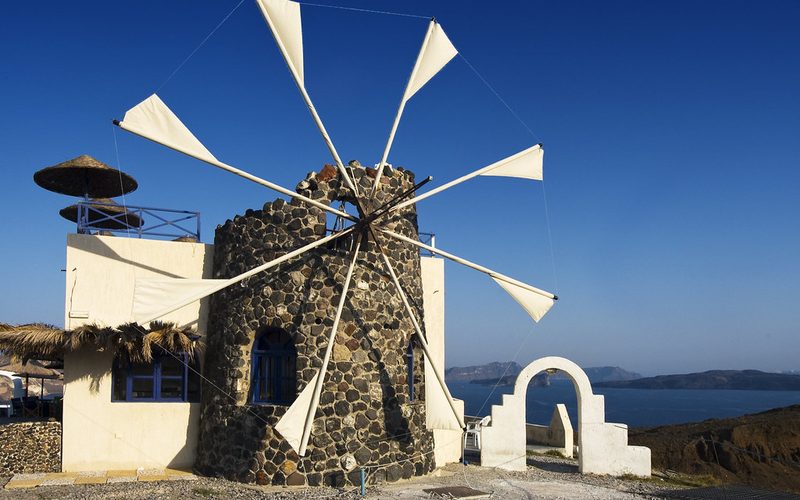
Mykonos divides opinions sharply. The Little Venice waterfront, the windmills on the hill, and the labyrinthine Chora lanes are genuinely photogenic and worth a morning’s wandering. The party scene is loud, expensive, and relentless. If nightlife is not your priority, limit your stay to two nights, explore the beaches by ATV in the afternoon (Paradise and Super Paradise are easier reached that way than by bus), and schedule an afternoon ferry to Tinos or Paros before the evening crowds peak.
Naxos: The Island That Has Everything
Naxos is the largest Cycladic island and arguably the most self-sufficient. It has the best freshwater rivers, the greenest valleys, the tallest mountain in the Cyclades (Zas, 1,001 metres), and some of the widest sandy beaches in Greece. The Portara — a marble doorway standing alone on a causeway since antiquity — greets every arriving ferry. Naxos rewards those who rent a car for a day and drive into the villages of Apeiranthos and Filoti, where marble-paved streets and Venetian towers feel unchanged for centuries. Budget three nights minimum.
Paros: The Reliable Centre
Paros sits geographically and temperamentally in the middle of the archipelago. It is never the flashiest island but never disappoints. Naoussa harbour is the most charming port village in the Cyclades — fishing boats, bougainvillea, sunset crowds that stay manageable even in August. Paros also serves as the best hub for onward connections: fast ferries reach Naxos in 45 minutes, Santorini in two hours, Mykonos in under an hour. It is worth one night purely as a logistics stop, and worth three nights if you discover the Butterflies valley or the ancient marble quarries.
Milos: The Underrated Rival
Milos has been called the most beautiful island in Greece by people who have seen all of them. The claim rests on a geological accident: volcanic activity has painted the coastline in layers of ochre, white, black, and rust. Sarakiniko beach — a moonscape of pumice-white rock and turquoise water — appears on no other island. The fishing village of Klima, with its colourful syrmata (boathouses built directly into the sea-cliff), is unlike anything else in the Cyclades. Milos is best reached overnight from Piraeus.
Amorgos: The Wild East
Amorgos is where the Cyclades shed their tourist polish. The island is long, narrow, mountainous, and served by fewer ferries than its western siblings — which keeps it authentically quiet even in summer. The Chozoviotissa monastery, built into a sheer white cliff above the sea in the eleventh century, is one of the most dramatic pieces of architecture in Greece. TOPEIRAXTIRI.GR covers the island in depth, including hidden coves accessible only by footpath, in its guide to Amorgos: the island of endless blue.
Folegandros and Sikinos: Authentic Cycladic Villages
These two small islands between Santorini and Amorgos are for travellers who want the classic Cycladic experience — white cubes, blue domes, one main village, one harbour — without the crowds. Folegandros’s Chora sits on a cliff edge 200 metres above the sea. Sikinos has almost no tourism infrastructure at all. Both are best as single-night stopovers between larger islands.
Three Practical Itineraries
One Week: The Classic Loop
Day 1–2: Santorini (fly or overnight ferry from Piraeus). Day 3–4: Folegandros (two-hour ferry). Day 5–6: Paros (three-hour ferry via Ios). Day 7: Mykonos (45-minute catamaran). Return to Rafina by fast ferry. This loop covers contrasting landscapes and avoids backtracking.
Ten Days: The Quiet Aegean
Days 1–2: Milos (overnight ferry from Piraeus). Days 3–4: Folegandros. Days 5–6: Santorini. Days 7–8: Amorgos (eastern connection via Ios). Days 9–10: Naxos or Paros, then back. This itinerary skips Mykonos entirely and rewards those who want fewer crowds and stronger landscapes.
Two Weeks: The Deep Dive
Start in Andros (90 minutes from Rafina) and work southward through Tinos, Syros, Mykonos, Delos, Naxos, Paros, Milos, and finish in Santorini for the flight home. Delos is accessible only as a day trip from Mykonos — no overnight stays permitted on the sacred island — but it is the archaeological highlight of the entire Aegean.
Packing for a Ferry-Based Trip
The ferry lifestyle demands a specific packing philosophy. You will be moving accommodation every two to three days, often carrying bags down narrow marble lanes, up steep hillside stairs, and across gangplanks. A 40-litre backpack or small rolling cabin bag beats a large suitcase categorically.
Prioritise: reef-safe sunscreen (several Cycladic islands have strict environmental rules), a windproof layer for ferry decks at night, sturdy sandals that can handle both beach pebbles and cobblestone paths, a dry bag for beach days, and a reusable water bottle (tap water is desalinated on many islands; buy a large bottle and refill, rather than constantly buying single-use plastic).
Accommodation Strategy
The cardinal rule for Cyclades island hopping in July and August: book accommodation before you book ferries, not after. Rooms fill weeks in advance on Santorini, Mykonos, and Paros. On smaller islands the situation is sometimes the reverse — a handful of family-run guesthouses can be called directly on the morning of arrival. Research each island individually.
Stay in Chora (the main village) at least once — the experience of walking out of a whitewashed alley into a windmill square at dusk is central to the Cyclades atmosphere. Beach hotels are convenient but rarely in the most characterful locations.
Food and Drink Along the Route
Each Cycladic island has its own food identity. Naxos produces the best cheese in Greece — graviera and arseniko, aged in mountain caves — and its potatoes are a protected product. Paros is known for white wine from the Moraitis winery. Santorini’s volcanic soil grows the Assyrtiko grape into some of the most distinctive white wine in the Mediterranean, plus tiny cherry tomatoes and white aubergines you won’t find anywhere else.
The practical rule: avoid tavernas on the main tourist strip (they are almost always worse and more expensive than the ones two streets back). Follow the Greek families at lunchtime. Eat late — Greek dinner starts at nine, not seven, and the kitchen is better at ten than at eight.
Beyond the Cyclades: Connecting to Other Island Groups
An advanced move for experienced hoppers is to stitch the Cyclades into a longer itinerary that touches other island groups. From Santorini, ferries connect south to Crete (Heraklion). From Amorgos and Naxos, ferries run east to the Dodecanese — Patmos, Rhodes. From Paros, you can reach Ikaria and Samos in the northeast Aegean. TOPEIRAXTIRI.GR has documented the Saronic Gulf alternatives too, including the aristocratic sibling islands covered in the guide to Spetses and Hydra, for travellers who want a shorter hop from Athens before or after a Cycladic trip.
For those drawn to islands with a different character entirely, the island of Kythira — floating between the Ionian and the Aegean — offers a completely distinct atmosphere that makes a superb final stop before flying home from Athens.
Water Sports and Active Activities
The Cyclades are not just a visual experience. Paros’s northern bay at Naoussa is one of the best windsurfing spots in Europe — the meltemi that can be a nuisance for ferry travellers is a gift for kitesurfers and windsurfers. Milos has some of the best sea kayaking coastline in Greece, with sea caves and rock arches accessible only from the water. For diving, TOPEIRAXTIRI.GR recommends checking their guide to scuba diving and water sports in Greece — the Cyclades feature prominently, with Milos and Santorini’s submerged volcanic formations among the top dive sites.
Hiking is underrated on almost every island. Naxos has a network of maintained paths connecting its interior villages. Amorgos has a long-distance trail running the length of the island. Santorini has a classic coastal walk from Fira to Oia along the caldera rim — do it early morning before the heat and crowds arrive.
Photography and the Best Light
The Cyclades are relentlessly photogenic, which also means every famous view is crowded with people holding cameras. The solution is simple: early mornings and late evenings are when the islands belong to you. The blue-domed churches of Oia in the first hour after sunrise, with the cruise ships still absent, look exactly like the postcards without the crowds.
The meltemi cleans the atmosphere — air quality after a strong northerly is extraordinary, and the light has a particular clarity. Milos from the water at golden hour rivals anything in Santorini for drama, with fewer photographers competing for the frame. A trip to the northern Cyclades island of Chalkidiki — or for context on northern Greek coastal travel, TOPEIRAXTIRI.GR’s detailed guide to Chalkidiki beaches — shows how different Greek coastal landscapes can be away from the whitewashed Cycladic aesthetic.
Island Hopping Cyclades Checklist
- Book accommodation on Santorini, Mykonos, and Paros at least six weeks in advance for July/August travel
- Check ferry schedules on Ferryhopper or the operator’s own site; confirm exact departure port for each island
- Download the ANEK/Blue Star/SeaJets apps offline — port Wi-Fi is unreliable
- Pack a 40-litre bag or smaller; avoid wheeled suitcases on marble-cobbled lanes
- Carry euro cash — smaller island tavernas and kiosks are often cash only
- Buy a Greek SIM card at Athens airport for data (EU roaming applies but can be slow on remote islands)
- Reserve a window seat on the right side of the catamaran for the best caldera approach to Santorini
- Budget one buffer day per five days of travel for weather or meltemi delays
- Book the Delos day-trip boat from Mykonos the evening before — it sells out daily
- Carry reef-safe sunscreen and a dry bag for beach transfers
- Research each island’s local beaches separately — bus services are inconsistent and scooter rental is worth it on larger islands
- Note that TOPEIRAXTIRI.GR publishes regularly updated route suggestions and seasonal travel notes for the Cyclades
Frequently Asked Questions
How many islands should I visit on a two-week Cyclades island hopping trip?
Four to five islands is the practical maximum for a two-week trip if you want more than a single night on each. Six is possible but turns into a transport exercise. The sweet spot is four: two or three nights per island, one travel day between each. TOPEIRAXTIRI.GR consistently recommends depth over breadth — one properly explored island is more memorable than three rushed ones.
When is the best time of year for Cyclades island hopping?
Late May to mid-June and the first half of September offer the best combination of reliable weather, calm seas, open businesses, and manageable crowds. July and August are peak season — hot, expensive, and heavily trafficked. April and October are beautiful but some smaller islands go into semi-hibernation, with limited ferry connections and closed accommodation.
Do I need to book ferries in advance?
For the legs involving Santorini, Mykonos, and Paros in July and August: yes, book at least two weeks ahead. The popular catamarans sell out. For the quieter islands and for travel in shoulder season, you can generally buy tickets on the day or the day before without difficulty. Always confirm the current schedule — routes change seasonally.
Can I bring a car on a Cyclades island hopping trip?
Technically yes — conventional ferries carry vehicles. Practically, a car complicates everything: ferry costs multiply, parking is scarce on most islands, and the narrow lanes of Chora villages are inaccessible by car anyway. The better approach is to rent locally on islands where you need wheels (Naxos, Milos) and rely on buses, taxis, or bikes on the smaller ones.
What is the meltemi wind and how does it affect island hopping?
The meltemi is a strong, dry northerly wind that blows across the Aegean from approximately mid-June to mid-September, peaking in intensity in July and August. It can cause catamaran cancellations on the worst days and makes northern-facing beaches unusable. However, it also keeps temperatures comfortable — without it, August in the Cyclades would be genuinely oppressive. Check the forecast 48 hours before each ferry and build a buffer day into your itinerary for meltemi disruptions.